2009 Imoca World Championship
1. Marc Guillemot 362pts
2. Michel Desjoyeaux 357pts
3. Armel Le Cleach 338pts
4. Samantha Davies 321pts
5. Vincent Riou 304pts
6. Dee Caffari 295pts
7. Arnaud Boissières 292pts
8. Brian Thompson 281pts
9. Steve White 250pts
10. Richard Wilson 220pts
11. Raphaël Dinelli 210pts
12. Norbert Sedlacek 200pts
13. Kito De Pavant 59pts
14. Loïck Peyron 52pts
15. Yann Eliès 44pts
16. Roland Jourdain 39pts
17. Mike Golding 36pts
18. Jérémie Beyou 33pts
19. Yannick Bestaven 32pts
20. Alex Pella 30pts
21. Pachi Rivero 18pts
22. Guillermo Altadill 16pts
23. Jean-Pierre Dick 8pts
24. Marc Thiercelin 4pts
25. Unai Basurko 0pts
26. Jean-Baptiste Dejeanty 0pts
27. Derek Hatfield 0pts
28. Sébastien Josse 0pts
29. Jean Le Cam 0pts
30. Jonathan Malbon 0pts
31. Bernard Stamm 0pts
32. Alex Thomson 0pts
33. Dominique Wavre 0pts
Today is a very important day in the Alex Thomson Racing calendar, as we prepare to launch our new Juan K Open 60 at Canary Wharf in London. The boat has taken 4 months to refit to create a race yacht that will provide Alex with the best chance of winning, and as the most powerful yacht in her class she promises some very interesting sailing.
She will be officially named and launched on the 27 May at a glittering HUGO BOSS event, in front of 600 guests including media, VIPs and celebrities. The boat will leave directly after the launch for a summer of corporate hospitality, racing events, and HUGO BOSS parties, hitting hot spots such as The Hamptons, Sardinia and Ibiza, before heading back to base for the build up to the Barcelona World Race.

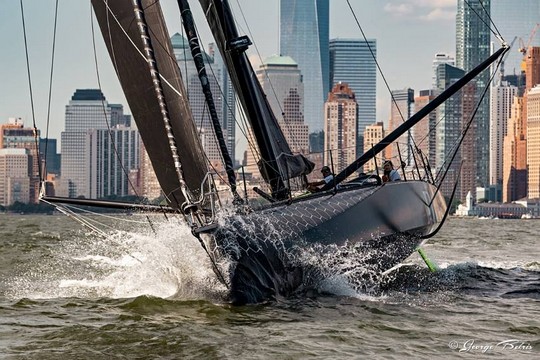
Hugo Boss Open 60. Shown here as the yacht is launched from slipway at Green Marine, Southampton (Photo By Lloyd Images)
The latest incarnation of the HUGO BOSS IMOCA 60 was given a brief airing on Friday as it was transferred from the Green Marine shed at Spitfire Quay, Southampton to Alex Thomson Racing’s base in Gosport.
Over the last 4 months the boat has been undergoing a dramatic modification and re-fit under the guidance of boat designer Juan Kouyoumdjian that will provide Alex Thomson with the most powerful IMOCA 60 in the World.
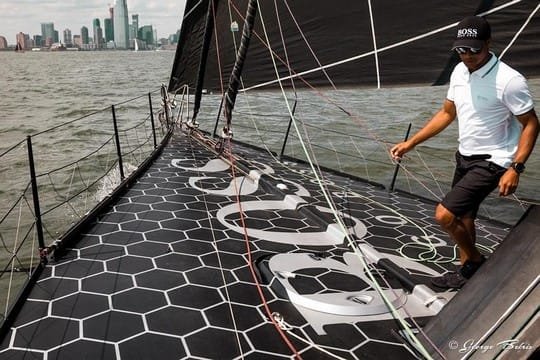
The boat, now virtually unrecognisable from the original Kouyoumdjian designed Pindar, features a number of radical changes that sets the boat apart from the IMOCA 60 fleet but, under the new grandfathering rule, keeps the boat within the restrictions set down by IMOCA. Alex Thomson Racing is confident that the results will lead to some exciting sailing.
“We’ve worked closely with Juan to create something that’s a bit special and we’re all really pleased with the result”, said Alex Thomson. “We’re in the process of fitting the rig and then we’ll be able to try her out. I’ve been looking forward to that moment for quite a while now”.
HUGO BOSS is due to be officially unveiled in all its glory at a high profile launch event in May. Alex Thomson will then embark on a six-month sailing programme that will take him up to the start of the Barcelona World Race in December where he hopes to go one better having finished second in the 2007/8 race.
Last August Alex Thomson was joined onboard his IMOCA Open 60 HUGO BOSS by former Olympic skier Graham Bell for the 2009 Rolex Fastnet Race. To watch their journey and get an exclusive view into life onboard the premier racing yacht HUGO BOSS tune into Channel Fiver on Sunday 10th January at 12 noon.
The 2009 Fastnet Race saw a hugely competitive line-up come together for this classic 600-mile offshore race. The 300 strong fleet included Olympic medalists, America’s Cup and round the world sailors. Lining up for his first race was former Olympic skier Graham Bell, a complete novice sailor onboard the IMOCA Open 60 HUGO BOSS one of the fastest racing machines on the planet. 2009 saw the 30th anniversary of the 1979 edition of the race, the race was brought to national attention after an extreme storm swept through the Irish Sea, 15 crew as well as 4 from the trimaran shadowing the race and two from a cruising yacht, tragically died. Only 85 boats finished, 194 retired, and 24 boats were abandoned. Graham speaks to sailors both past and present on their memories of this tragic event, and how technology has changed at sea over the last 30 years.
Date: Sunday 10th January
Channel: Fiver
Time: 12:00
FREEVIEW: Channel 30
SKY: Channel 176
VIRGIN MEDIA: Channel 152
TISCALI TV: Channel 31
Following the Fastnet Race, HUGO BOSS then took part in a challenging two handed Transat Jacques Vabre. The 14 strong IMOCA fleet were battered by storm force conditions in the North Atlantic, causing multiple breakages and one boat to be abandoned. On day nine the race was cut short for HUGO BOSS after a collision on the bow, although the damage was small it wasn’t possible to stop the ingress of water until the area was free from water. Sadly HUGO BOSS was force to retire and after a affecting a temporary repair headed back to the UK.
HUGO BOSS has been surveyed after the collision, and the results showed the damage is minimal. Skipper Alex Thomson commented, “The team are currently working on the repair. The potential was there during the Jacques Vabre, it was so frustrating to have to retire when she had performed so well
Dee and Brian completed the two-handed Transat Jacques Vabre race from Le Havre, France to Costa Rica onboard Aviva. The first week of the race saw the fleet battle through some extreme weather conditions and subsequent damage to boats forced four Open 60’s, including fellow British sailor Alex Thomson, to retire from racing.
Dee and Brian had their fair share of problems but were able to replace a lost wind instrument in a becalmed period. Generator issues meant that both sailors had to hand steer for the majority of the time as they were without the pilot, however, a speedy pit stop in St Lucia for a generator part enabled them to get powered back up and stay in the race. Towards the final stages, the duo raced hard to finish in 8th position from an original fleet of fourteen IMOCA Open 60 yachts that started the transatlantic race 19 days ago. In the last few hours of the race Aviva experienced very light winds making for a frustrating and protracted finish into the port of Limon.
The Transat Jacques Vabre was the last of the races validated by IMOCA in the two year Open 60 season and Aviva’s result earned additional points for both Dee and Brian. Out of 33 skippers, Caffari was ranked 6th, in her first full IMOCA season, and Thompson 8th. The World Championship title was won by Marc Guillemot, skipper of Safran.
Dee commented:
“To have finished 6th in the IMOCA rankings, alongside noted sailors like Michel Desjoyeaux and Marc Guillemot is an added bonus and makes me very proud of how much Aviva and I have achieved in the past two years.”
On arriving at the dock in Port Limon, Dee said:
“ The race was long and it was hard, in three different parts, the beginning and the stormy stuff, getting sorted out and then the finale in the Caribbean Sea. So it was very eventful, highs and lows. We have things to deal with and obviously a frustrating finish, but to be this close at the end of a race has been cool.
This is in a different league to my last Transat Jacques Vabre. Sailing with Brian has been great. He is cool and calm and you think: ‘ok this is fine and you get on with it.' So the intensity I have dealt with is much greater than I am used to. It was a much more enjoyable race than the Vendée Globe, and it was nice to be in among the people who were leading. The company I am keeping now is something I never even dreamed of. Now I want to carry on. I need to find the backing but I feel like I am growing at such a speed. This was a great race to do, you learn so much with the right person on board.”
Having now had chance to enjoy the creature comforts of dry land, like a shower, fresh food, a long sleep in a real bed and interaction with lots of people all at once, I have had chance to reflect on the race.
Having worked so hard and held such good positions during the race eighth place was disappointing at the time. The reality is that any of the four boats finishing with us could have finished in fifth and any order could have followed. We were in squall territory and it was a certain amount of luck for the final few miles. Even the conversations ashore with the other skippers and people involved in the race have all been talking about our huge gains at the end and also how fast we were at the start and during the big storm we all faced during the first week. This has off course made me feel better and I cannot deny I loved sailing Aviva again in a big race and it was great sailing with Brian. We had some problems to face and we did it all in a positive manner and had huge fun as well as the hard sailing together.
Now we are preparing the boat for the delivery home. Hannah Jenner and Katy Miller are busy helping with jobs on the boat to learn their way around as they will be joining James and Harry for the trip home. Let’s hope they will be home for Christmas. I know Aviva will look after them and I am confident that they will look after her well for me.
On arriving at the dock in Port Limon, Brian Thompson said:
“It was an interesting place to have the stealth play. There were light winds to the south on the more direct course, so people were deciding how far north to go, and we went a fairly direct course. It turned out there was a front which came through from Panama which gained us, we got through it early in the day and had clear skies for the rest of the day. Then we had nice sailing for the afternoon, maybe a little slower but we sailed less miles. But then we were next to W-Hotels and we thought it was Akena, but it was W-Hotels who had been 100 miles ahead. Then we were in constant squalls one after the other and were never becalmed until right near the end. They must have had the one squall which drove them all the way in.
It was a perfect, swashbuckling finale to bring the ninth edition of the Transat Jacques Vabre two handed transatlantic race towards its final conclusion. Marc Guillemot and Charles Caudrelier played the starring roles some days ago, Guillemot the hero of the Vendée Globe winning the top prize, but the final full day of racing proved a cliffhanger.
After over 5,300 miles and nearly 20 days of racing, when all four protagonists, scrapping over 5th to 8th places emerged from the cover of stealth mode at 1000hrs GMT/UTC (0400hrs local) this morning, less than eight miles separated fifth placed Veolia Environnement (Roland Jourdain and Jean Luc Nélias) from seventh placed Aviva (Dee Caffari and Brian Thompson).
And Akéna Vérandas (Arnaud Boissieres and Vincent Riou) was a further 15.1 miles behind the British duo
Having held fifth place for five days - since they broke into the Caribbean - the Spanish duo on W-Hotels, were never going to give it away easily.
Passed for the second time in the final 12 hours by Veolia Environnement, when the French duo rocketed off into the rainy gloom of yet another squall, on the strength of a sail change the Spanish pair just could not make in the gusty 25 knots breeze, they felt that they were destined for sixth.
But their determination never wavered.
The next squall brought them back to rescue their fifth, arriving like a spectre from out of the murk at 17-18 knots to haunt Veolia for the third and final time, just half a mile from the finish.
It was perhaps appropriate that the surprised Spaniards - on their own voyage of discovery, racing an IMOCA Open 60 for the first time ever - cemented their success arriving Puerto Limon, in the wake of their legendary forebear Christopher Columbus who sailed to the New World in here in 1502.
Ribes and Pella finished four minutes and 16 second ahead of their French rivals, exhausted but pleased to have taken fifth, in between two of the most successful IMOCA Open 60 racing skippers, Michel Desjoyeaux and Jourdain.
They had only sailed together for a few days before embarking on this race, and learned as they came down the track. Standing smiling in the torrential rain on the dockside they admitted to many mistakes and ‘beginners errors’ but they can be justly proud of their result in this highest quality field.
The Spanish were delighted. But there was disappointment for Dee Caffari and Brian Thompson on Aviva. At one point they were, according to Ribes, 100 metres away from Aviva.
They waited for the British pair to tack and, in the end, chose to do their own thing, gaining 15 miles in to the finish.
The British pair slowed in a final light zone, losing out to Akéna Vérandas in the last stages to finish eighth, just 27 minutes behind the 2004-5 Vendée Globe winner Vincent Riou and skipper Arnaud Boissieres.
Caffari and Thompson’s disappointment in losing out in the high stakes scuffle, which was largely carried out in torrential tropical rain and changeable winds, was obvious but Caffari reflected enthusiastically on how much she has improved since she competed in the last edition in 2007 as an IMOCA greenhorn.
All four boats finished within just over three and a half hours. 1876 was due to finish by around 1800hrs GMT and Sam Davies and Sidney Gavignet on Artemis later tonight.
Quotes:
Pepe Ribes, (ESP), W-Hotels:
“ The last 36 hours have been no sleep, no eating, nothing. We played the stealth card and so did everyone else at the same time. And when we played the stealth it was the first time that we saw a boat, with Veolia just crossing our bows, that was yesterday morning. Then since then we passed them once and then they passed us again, then we passed them again just half a mile from the finish line. I really don’t know what made the difference in the end. We went to the beach and then we saw Aviva, who were very close to us, only 50 metres away.
We went with Aviva to the beach and we waited for them to tack but they did not tack, and so we tacked and from there we were reaching really, really fast maybe 18-19 knots.
Then we saw a light and thought it was a cruising boat. We were sure Veolia were way ahead. In one of the squalls they managed to drop their spinnaker and put up their masthead genoa and go straight, so we had to bear away. So they left. And when we saw a green light we thought it was a cruising boat. I looked with the binos and told Alex and we could not believe.”
“ I think it is good result for us, very very good. We were not expecting such a good result at all. We did not know the level, and for me I thought between tenth and fourteenth and we finished fifth, so, fantastic. It is a good result for me, and I hope for Spain.”
“ I feel very, very tired. But we made many, many mistakes. At the beginning, not so much now. We made a lot of mistakes and lost a lot of miles. But we are going forwards.”
“ I think we were pushing the boat very, very hard and broke a lot of things. We were good together. We tried to share everything and learn about each other. He has a lot of strong points and I have strong points and it works well. He is more like an offshore sailor, more relaxed and I am more go, go, go. It is a good mix, I am always 100%. We pushed, I don’t care, I sail it like a Volvo boat, we keep pushing and I don’t care if the boat breaks.”
“But we made mistakes, it is double handed and it is new for us.”
Alex Pella (ESP) W-Hotels:
“ The boat is OK, but we broke a lot of small things, the spinnaker. We had problems with the pilots, sometimes they worked, sometimes they did not work. But we fived them with a spare compass, and they worked, and then two days later they did not. But the boat is nice and work towards the Barcelona World Race.
Pepe is a very good sailor. He has so much experience and pushes very hard, he has experience with the Volvo boats which helped, and I learned so much from sailing with Pepe.”
“ On the one hand he is a very methodical guy, very ordered but he wants to push all the time, to push hard.”
“ At the beginning of the race we had decided to go south, but then when we saw some going west, we said ok we try to catch this option but it was too late. In fact there was a time when we tried but we were too late. We went with the wrong option.
But we are here!”
“ Foncia and Akena went further south. We had a maximum of 50 knots in the third storm and big waves.”
“ I am really, really happy. We are hear to learn the boat. This is a training for the Barcelona World Race and here we are in Costa Rica, it is incredible….in between Foncia and Veolia. It is fantastic!”
Dee Caffari (GBR) Aviva:
“ The race was long and it was hard, in three different parts, the beginning and the stormy stuff, getting sorted out and then the final in the Caribbean Sea. So it was very eventful, highs and lows. We have things to deal with and obviously a frustrating finish, but to be this close at the end of a race has been cool.
This is in a different league to my last Transat Jacques Vabre. Sailing with Brian has been great. He is cool and calm and you think: ‘ok this is fine and you get on with it.’ So the intensity I have dealt with is much greater than I am used to. It was a much more enjoyable race than the Vendée Globe, and it was nice to be in among the people who were leading. The company I am keeping now is something I never even dreamed of..
Now I want to carry on. I need to find the backing but I feel like I am growing at such a speed. This was a great race to do, you learn so much with the right person on board.”
Brian Thompson (GBR) Aviva:
“It was an interesting place to have the stealth play. Ther were light winds to the south on the more direct course, so people were deciding how far north to go, and we went a fairly direct course. It turned out there was a front which came through from Panama which gained us, we got through it early in the day and had clear skies for the rest of the day. Then when had nice sailing for the afternoon, maybe a little slower but we sailed less miles. But then we were next to W-Hotels and we thought it was Akenas, but it was W-Hotels who had been 100 miles ahead. Then we were in constant squalls one after the other and were never becalmed until right near the end. They must have had the one squall which drove them all the way in.”
Roland Jourdain:
“Before, it was the English, now we have the Spanish! It was hard.! It was tough but fun, a great race for first place in this second group! It was intense with many challenges. We knew this course would be more varied in terms of the different weather conditions and that really was the case. We even had our small technical pit stop, we like them with Jean-Luc. That’s why I plan to make stages races. We would like to have played with the top of the fleet. The technical stop we could have done without. We did not think it would cost us. We were optimistic but saw time slipping.
Marco went very fast and I agree they went the right way, with the good options, but they went really, really fast.
Yesterday morning it was hell. We waited for the wind from the east and north and had southerly. We saw a boat behind and managed to escape. Yesterday evening we saw it again and gybed away. In a squall we tacked and put five miles on them. And then this morning we were sitting all but still and a racing car arrived, someone so quick we thought it was a motor boat.”
“But our boat is OK, it went well but on the other hand it is not a new boat. Veolia has gaps compared with the new boats. We still go well and make results because I know this Mobylette but it is nevertheless frustrating.”
Jean-Luc Nélias, FRA (Veolia Environnement):
“We passed W-Hotels in a squall, but they negotiated them better. When we cam out from stealth, we realized we had made five miles on them, and then this morning we took another squall and got it back. From a result point of view we are not that happy. We could have battled it out with boats such as Mike Golding but the others are faster. It is nevertheless frustrating because out mainsail mast track was broken. The first reef has been very useful. But we are glad we got here. We laughed a lot with Bilou. It was a good adventure.”
Times summary
Breaking the finish line at 11:41:44hrs GMT Friday 27th November (05:41:44hrs local time, Costa Rica) after sailing for 18d 22hrs 11mins 44seconds at an 10.41knots average for the theoretical course (4730 miles) since leaving Le Havre on Sunday 8th November, Spain’s Pepe Ribes and Alex Pella on W-Hotels took fifth place in the IMOCA Open 60 class in the ninth edition of the Transat Jacques Vabre two handed Transatlantic race. Ribes and Pella sailed a distance of 5790 miles at an average of 12.75kts.
W-Hotels finish 3 days 2 hours 49 minutes 34 seconds behind the winner Safran.
Breaking the finish line at 11:46:00hrs GMT Friday 27th November (05:46:00hrs local time, Costa Rica) after sailing for 18d 22hrs 16mins 00 seconds at an 10.41 knots average for the theoretical course (4730 miles) since leaving Le Havre on Sunday 8th November, France’s Roland Jourdain and Jean Luc Nélias on Veolia Environnement took sixth place in the IMOCA Open 60 class in the ninth edition of the Transat Jacques Vabre two handed Transatlantic race. Jourdain and Nélias sailed a distance of 5734miles at an average of 12.52kts.
Veolia Environnement finish 3 days 2 hours 53 minutes and 50 seconds behind the winner Safran.
Breaking the finish line at 14:50:12hrs GMT Friday 27th November (08:50:12hrs local time, Costa Rica) after sailing for 19d 1h 20m 12s seconds at an 10.34 knots average for the theoretical course (4730 miles) since leaving Le Havre on Sunday 8th November, France’s Arnaud Boissières and Vincent Riou on Akena Veranda took seventh place in the IMOCA Open 60 class in the ninth edition of the Transat Jacques Vabre two handed Transatlantic race. Boissières and Riou sailed a distance of
5823miles at an average of 12.73kts.
Akéna Vérandas finished 3days 05hours 58min 02s seconds behind the winner Safran.
Breaking the finish line at 15:17:12hrs GMT Friday 27th November (09:17:12hrs local time, Costa Rica) after sailing for 19d 1h 46m 12s seconds at an 10.33 knots average for the theoretical course (4730 miles) since leaving Le Havre on Sunday 8th November, Great Britain’s Dee Caffari and Brian Thompson on Aviva took eighth place in the IMOCA Open 60 class in the ninth edition of the Transat Jacques Vabre two handed Transatlantic race.
Caffari and Thompson sailed a distance of 5700 miles at 12,45 knots average .
Aviva finished 3d 06h 25min 02secs behind the winner Safran.
Too late to play cat and mouse….. it seems like Safran – the super light, quick IMOCA Open 60 boat the sponsors like to call the ‘jet fighter’ – will have devoured Groupe Bel by the time that the Transat Jacques Vabre leader appears from under the cover of ‘Stealth Mode’ to cross the finish line off Puerto Rica this evening to take a well deserved, hard earned victory.
Both of the leading pair, Safran and Groupe Bel, pressed the stealth button in unison together to complete their final miles away from the public tracking system, but at eight this morning Marc Guillemot and Charles Caudrelier-Bénac were already champions elect, with a 90 miles lead and less than 200 miles of the gruelling 4730 miles course from Le Havre to the finish off Puerto Limon, Costa Rica.
While Bel was last seen tracking slightly north in search of some last minute bonus miles as the trade winds fold, Safran was steadily rolling down towards the finish line, on the verge of a significant triumph. Second in the last edition of the race in 2007 and an heroic third on the last Vendée Globe when Guillemot brought the wounded Safran the final 1000 miles with no keel, Safran has lead this race since Thursday 12th, before battling through the storm of Friday 13th.
Guillemot was predicting a slightly ‘sluggish’ finish in light winds, but could not see any obvious reason why their long time rivals Kito de Pavant and Francois Gabart on Groupe Bel should close that significant gap.
“We still have a few more gybes to go and the final 50 miles look like being rather sluggish, but the lead we currently have allows us to remain composed. The lead over Groupe Bel could be cut, but we’re certainly not going to give anything away now.” Guillemot told his team today, happy with the routing they have taken since leaving the English Channel 14 days ago,
“We know that we have left a smooth trail in our wake. As not everything can be done by the two of us together, on the weather it was Charles, who did most of the work picking up and analysing the data. Then, we took decisions together. We always agreed about them.”
And they have always pushed extremely hard:
“With one or two exceptions, we always sailed with the maximum amount of sail. That requires a lot of energy. It really drained our reserves to carry out these manoeuvres and there were many of them. If we do manage to win, it will certainly feel good, as we really gave it our all throughout this race.”
Built-in reliability has been one of the keys to the two leaders successes this race After being hobbled by gear problems, not least a damaged main sail mast track in the Vendee Globe, Guillemot reports that their only damage is to their big spinnaker and slight mainsail damage.
The battle for line honours, between Crepes Whaou! – the Multi50 – and Safran is in the balance. While Franck-Yves Escoffier was relishing the chance to beat the monohulls home, the three times winner of the Route du Rhum and twice winner of his class in this race, is keen to break the finish tape first.
Mike Golding’s power problems have continued and the British skipper and his Spanish co-skipper Javier Sanso have been unable to start their engine for the last 48 hours and so are running with next to no electrical power. Mike Golding Yacht Racing had acceded a few miles to fourth placed Foncia but still has over just under 200 miles in hand over the double Vendée Globe winner with 412 miles to go to the finish. Foncia has been consistently quicker, while Golding’s avowed intent recently was simply to get across the finish with his boat and the podium finish intact.
Spanish fortunes are both climbing and declining. Alex Pella and Pepe Ribes on W-Hotels are positively buoyant with their speed on the Farr design, making miles all the time on Veolia Envirinnement and Aviva. Adding more sail area, to the main and their spinnakers, is paying a regular dividend as is their hard driving style. Meantime 1876 was just emerging back into the trade winds again but has dropped to ninth
Quotes
Franck-Yves Escoffier (FRA) Crepes Whaou:
“Yes we are still hoping to get in before the IMOCA’s, even if our chances are reduced a little, we are little quicker on a straight course, but at night we tend to take the foot off the accelerator. But we are always truthful that our aim, that is for sure. When it happens, whoever is first – us or the IMOCA’s – there will not be very much in it. We think we will arrive during the night (Costa Rica time) But a little mouse told us there will not be much wind when we are arriving so nothing is for sure. We have fed flying fish with Whaou Crepes, they seem to like them because they keep coming back to the boat.
When we get there I will be congratulating the Crepes Whaou designers, saying to Vincent, to Erwan, Kévin and the others, that we have been on a boat which is great. It is good and looks good, which is good because I wanted a boat which was faster and more powerful, and I think that goal has been met.”
Marc Guillemot (FRA) Safran:
“All is good on Safran. We decided to go in stealth mode. We thought about it while passing through the West Indies, then thought about it yesterday but finally we went for it today. I understand it can be frustrating for those on shore, but it adds a bit of spice. But it’s a card to be played and it would be stupid not to use it before the end. There was a difference of 90 miles and with 250 miles to go, I don’t think we needed it or it will help in any way, there no great gains to be made. I don’t think we need to worry unduly about big surprises, unless Kito and Francois expect a big surprise. For the moment we have not really looked too closely at the weather forecasts to the finish, we are happy to be just racing in and to trim the sails. We kind of saw this time coming a couple of days ago. And we don’t have to do too much to push the boat. We have not really thought about breaking the finish line. Over this race focus has been 100% on the sporting result, there have been no side adventures, since the start gun the focus has just been on getting to the finish. These boats are very demanding, they require a lot of hard work to make them go. The physical effort has been great and we are tired of all the manoeuvres. If Crepes Whaou! get in first, so be it, it won’t bother me. And it would be good for Franck-Yves and Erwan but what interests us is in getting in before Groupe Bel and the others. They are a different class and did a different course.”
Yves Parlier (FRA) 1876:
“We have finally reached the trade winds and now have a much better speed, but we have been through some areas of terrible calms for the last 24 hours. We have started to have really hot conditions; there is a lot of light but not a cloud in sight. Yesterday it was 35º inside the boat, and now it is 32 with no shade at all. We have water so there is no worry of being dehydrated. However for the connections and the screens the pilots are broken, and so right now I am at the chart table and trying to drive at the same time with the only pilot that is working still. I am lying down at the bottom of the boat, head up looking at then gennaker through one window and when I want to correct the pilot I have to move, but at least I am in the shade! Pachi has just had a short rest as he has spent a lot of time taking the pilots apart and trying to repair them.”
“We are not too surprised that we were overtaken as until just a while ago we were only making two knots. But the road is still long and we hope not to lose any more positions, and even try and win something!”
Pepe Ribes (ESP) W-Hotels:
“Things are going extremely well. It is downwind in the Caribbean Sea, spinnaker, shorts and beautiful sailing here today. We are a bit surprised by our downwind speed, the last five or six days. In the Istanbul Race we were able to keep up with some of the boat here but now we faster than them, so the changes we have made are paying off.
We have a new main, much bigger, 17 sq m, and we have changed to downwind Quantum Sails, and so little by little we are getting better.”
“We are pushing very hard, the others will be doing the same. But it is hard, 12 hours every day on deck, the secret to be fast is not to use the auto-pilot, to steer as much as possible, you have to steer.”
“I think we are OK, a long way to go. We are maybe 50 miles to leeward of Veolia and maybe 120 miles to leeward of Aviva and it is a downwind race. We are sailing fast and in a good position.”
“ We share everything. Normally Alex pulls the grib files when he is off watch, but at the moment I am doing the weather. And we are sharing everything, we share the helm and just keep changing. We have little problems with the batteries and so on, but I hope we will be able to sort it out and have no more problems.”
In between the simple routine of just keeping their boats at maximum speed in the right direction, and picking their way as best they can, there is a certain quiet satisfaction underpinning the efforts of the top three duos in the IMOCA Open 60 fleet as these Transat Jacques Vabre leaders set themselves up to break into the Caribbean.
That is not to say that any of them have already accepted their position now will be the same when they cross the finish line off Costa Rica’s Puerto Limon, but with the gap between leader Safran and second placed Groupe Bel grown by 20 miles to 81 miles early this morning, and the margin between Bel and Mike Golding Yacht Racing, in turn 82 miles, then each feels they have breathing space which they perhaps did not expect this morning.
Instead of the expected initial compression, in fact Marc Guillemot and Charles Caudrelier slipped away another 20 miles overnight on Safran, a gain which surprised Guillemot’s co-skipper enough to wonder this morning if their pursuers had a technical problem.
But in fact Safran has just had more a little more wind.
Satisfaction, such as it is, aboard Mike Golding Yacht Racing comes from being back in something closer to full racing shape after British skipper Golding spent much of yesterday night dealing with an electrical charging issue which firstly meant they could not start the engine, which then developed so they had a complete power failure.
But for his hard day’s night and recuperation yesterday Golding has remedied their problems and was pleased to be back in a more competitive mode early this morning.
Winds for the leaders are still very up and down, variable in direction. The leading trio have anything between seven and 12 knots this morning and winds will drop more at times as they approach the arc of West Indies islands
But the gap back to Michel Desjoyeaux and Jérémie Beyou has also opened another 20 miles to 290 miles between Mike Golding Yacht Racing and Desjoyeaux’s Foncia. Golding said his preference this morning would be to have been a little more south, but given his problems yesterday that has not been possible.
Dee Caffari and Brian Thompson creep closer to fifth all the time, this morning getting to less than 17 miles of Veolia Environnement their slightly more southerly position has been beneficial to the British Aviva duo, but both were slowed to less than ten knots this morning.
Battle continues in the middle order of the Transat Jacques Vabre
After successfully regaining sixth place yesterday and battling hard to maintain their position overnight, Dee Caffari and Brian Thompson onboard Aviva have narrowly lost out to 1876 in this morning’s polling.
The three boats currently in the middle of the fleet – 1876, Veolia Environnement and Aviva – are all positioned within 15 miles of each other and with over 2000 miles of the route to Costa Rica remaining, the battle for fifth to seventh place is set to continue.
The 10h00 race ranking positioned Dee Caffari and Brian Thompson, onboard Aviva, in seventh place, 575 miles behind race leader Safran.
“We have just spent darkness coasting along in a dying breeze under a canopy of bright stars. Flat water and warm temperatures have made it an uneventful but also a wonderful night’s sailing.
As predicted we will be fighting light airs with those around us. If we can keep working hard and keep at the front of this little group then we will reach the stronger breeze about 36 hours quicker. It is amazing getting a grib file now for weather information and realising how far we have come because we are also getting the Caribbean weather too.
To play tribute to this particularly tropical theme we also celebrated shower day onboard Aviva. So now she and her dynamic duo smell of roses as you would expect.”
Franco-Spanish duo Yves Parlier and Pachi Rivero are on good form this morning, making west at good speed in good breeze. On the quickest boat in the fleet just now, 1876 Rivero remarked that they will make their move south later today, but just 40 miles of DTF (distance to finish) separates fifth from eighth.
Quotes:
Mike Golding (GBR) Mike Golding Yacht Racing: “We had a problem, a big problem. As the batteries got low the engine would not start, and so the engine start batteries had not been getting trickle charge and so the engine would not start. That created an earthing problem on the engine as well, and so with no engine…no lights, nothing at all. It was pretty dodgy for a while. The switchboard 12v charger has blown, we had a spare but it has blown as well, so what I had to do was lift one of the main batteries out of the bank and use it to start the engine, so that took up most of yesterday night and the boat was a complete tip after that. So yesterday was spent getting tidied and getting the boat moving again, so so far tonight has been relatively quiet. We had no electronics, no navigation, no electronics, and it was pitch dark and so trying to see the wheel compass is hopeless. So we have ended up where we are. I am not especially pleased…we are where we are, we should be further forwards, we should be further south, but we are where we are.
I think there may still be some options and opportunities, but meantime we do need to make sure we get out of this light stuff. We probably haven’t done the job we wanted to to get out of it, we are doing 10 knots just now and probably have eight knots of breeze.”
Charles Caudrelier Bénac (FRA) Safran: “ It is going very well. We are trying in a way to understand what is going on because we expected less wind but that is not so. There must be a reason why we have gained so many miles on Groupe Bel during the night, maybe they have some technical problems?
We had a good night, between 10 and 15 knots, rolling along, and it makes good speed. We did two or three watches of three hours each and made no sail changes so it did not go too badly, and there are no clouds or squalls. But on the other hand the trade winds are broken down, and if there are no clouds during the day it will be hard because there will be no wind.
We are 1500 miles from the finish and it is just great. We can still break things if there are stronger trade winds, and there will be many manoeuvres before we get there.”
“The passage through the West Indies arc? Well it can make a big difference and we have already chosen, but we are not telling anything……”